
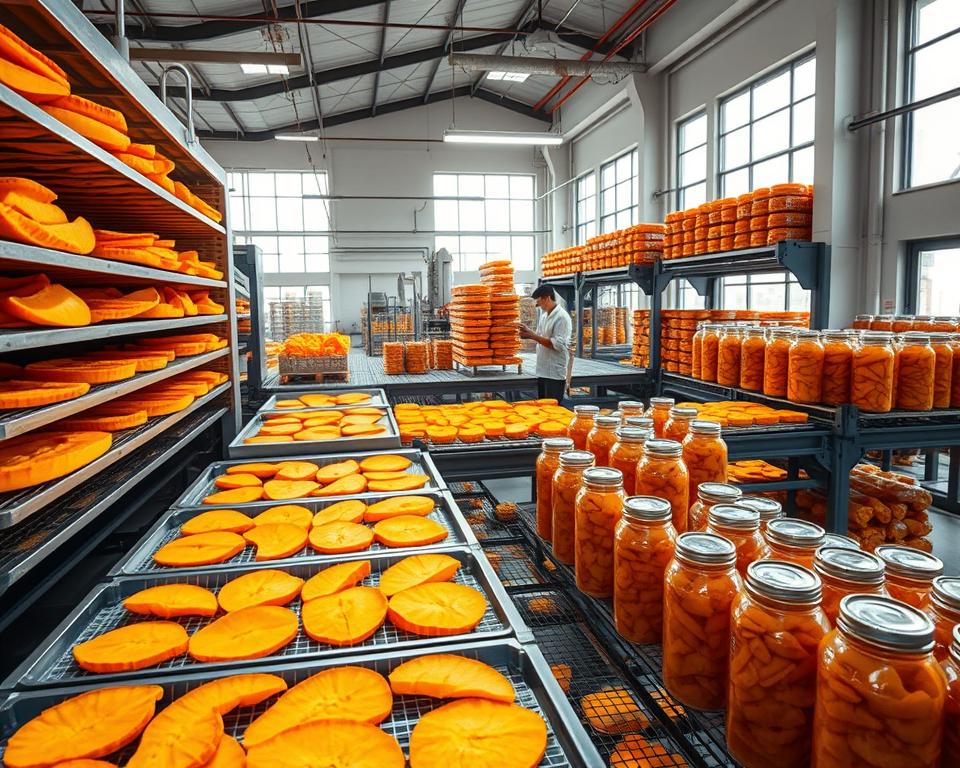
Starting a dried mango factory in Vietnam makes mangoes available all year. It turns fresh fruit into products that last longer. This includes steps like picking, washing, and drying.
A mango dehydration facility makes dried mango slices and powder. It also creates byproducts like animal feed. This helps the factory make more money.
What you need to start includes mangoes, water, and energy. You also need packaging and workers. Deciding on size, automation, and location is key to success.
Key Takeaways
- A dried mango factory converts seasonal fruit into higher-margin, long-life products for domestic and export markets.
- Common products are dried mango slices, sugar-treated variants, and mango powder; peels and seeds add byproduct value.
- Essential inputs include fruit, water, energy, packaging, and skilled labor; site choice matters for raw-material access.
- Investors should weigh capacity, automation, product mix, and regulatory compliance when planning a mango drying plant.
- Efficient mango dehydration facility design reduces post-harvest loss and improves profitability for Vietnamese producers.
Why a Dried Mango Factory Makes Business Sense in Vietnam
Vietnam is a top mango producer in Southeast Asia. Farms in the Mekong Delta grow lots of mangoes during certain months. Having a dried mango factory near these farms saves time and reduces fruit loss.
Fresh mangoes are only available for a short time each year. Turning them into dried products helps keep money coming in all year. Mango processing in Vietnam turns extra fruit into dried slices and purees that last longer than fresh mangoes.
There’s always a demand for dried tropical fruit worldwide. Europe, the Middle East, and North America buy mango products. Companies that export mangoes from Vietnam and meet food safety standards get better prices.
Setting up a processing plant creates jobs in rural areas. A medium-sized factory needs people for sorting, peeling, drying, and packing. This boosts local incomes and helps villages near the factory.
Government programs and private investors help new businesses start. They offer incentives for agro-industry and support for cold-chain development. Places close to ports and refrigerated storage are best for getting products to market fast.
Seasonal changes can be a challenge. Planning ahead and using contract farming helps get fruit when it’s needed. Many factories also make other fruit products or purees for different uses to stay busy all year.
| Consideration | Benefit | Practical action |
|---|---|---|
| Raw material access | Lower input cost, fresher fruit | Site plant within 50 km of major orchards in Mekong Delta |
| Seasonality | Revenue smoothing through processing | Invest in drying and puree lines to handle peak volumes |
| Export opportunity | Higher margins in certified markets | Obtain HACCP, ISO, and EU/US approvals for mango export Vietnam |
| Local impact | Employment and rural development | Train local workforce in food safety and production roles |
| Support and logistics | Lower effective costs and faster shipping | Leverage incentive schemes and position plant near ports |
| Risk mitigation | Improved asset utilization year‑round | Diversify into mango processing Vietnam for multiple product lines |
Core production process for dried mango
First, we check the mangoes for ripeness and no damage. We sort them by size and type. This makes drying even and reduces waste.
Then, we clean the mangoes thoroughly. This step meets food safety standards. Clean mangoes also protect our equipment and prevent contamination.
We peel and destone the mangoes next. This is done using special machines or steam. It makes the fruit ready for slicing and cuts down on waste.
After that, we slice the mangoes to 8–10 mm thickness. This helps with drying and texture. Uniform slices are key for quality.
Blanching in warm water stops browning and kills bacteria. We drain the slices quickly to keep them fresh.
Some mangoes get a sugar soak or sulphiting treatment. This keeps them looking good and fresh longer. But, we must follow export rules.
Drying can be done in several ways. We choose based on quality and cost. The goal is to dry the mangoes without losing flavor or color.
After drying, we cool and condition the mangoes. This step stops them from getting soggy. It makes them ready for packaging.
We package the mangoes in airtight bags or boxes. This keeps them fresh for a long time. The packaging also affects how they look in stores.
We also handle byproducts like peels and seeds. They are used for compost or animal feed. We treat wastewater to protect the environment.
The table below shows the main steps in making dried mango. It includes typical details and notes for a plant in Vietnam.
| Step | Typical Parameters | Practical Notes |
|---|---|---|
| Receiving & Inspection | Ripeness 8–9, size grading | Sort by variety to even dehydration and yield |
| Cleaning & Washing | Flowing water, sanitizing rinse | Reduces microbes and protects downstream quality |
| Peeling & Destoning | Steam or mechanical peelers | Speeds throughput; reduces tannin transfer |
| Slicing | 8–10 mm thickness | Uniform slices improve drying uniformity |
| Blanching | 70–80°C, ~15 seconds | Controls enzymatic browning and microbial load |
| Optional Treatment | Sugar soak or sulphiting | Follow regulatory limits for export markets |
| Drying/Dehydration | Hot air, vacuum, heat-pump, or freeze | Choose method that balances quality and cost |
| Cooling & Conditioning | Controlled temp and RH | Prevents reabsorption and clumping before packing |
| Packaging & Labeling | Airtight pouches, cartons, drums | Label to meet export compliance and shelf claims |
| Byproduct Handling | Peels, seeds, wastewater | Reuse, compost, feed, or treat per regulations |
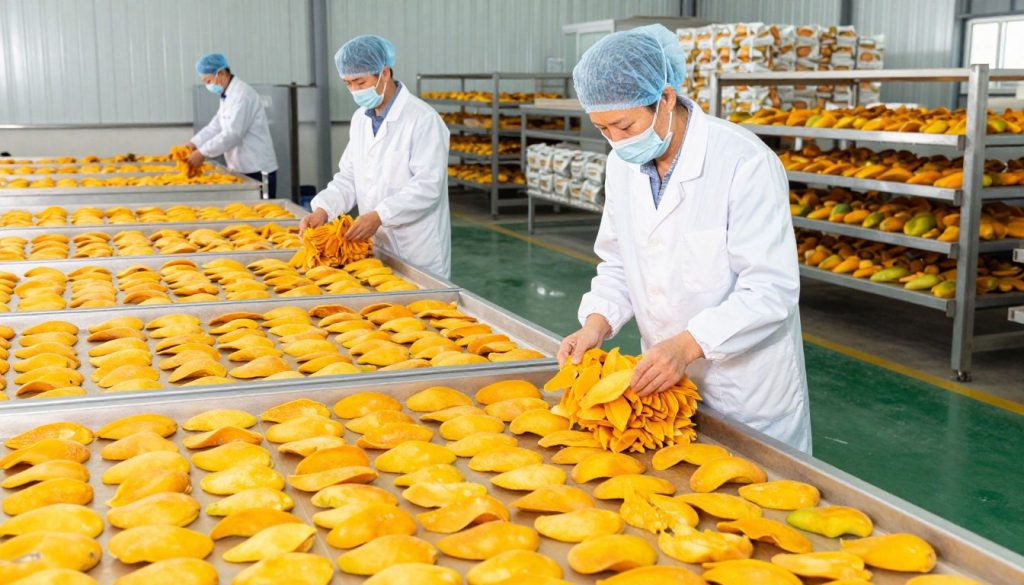
Top dried mango factory essential equipment
Starting a dried mango line needs a clear list of equipment. This list helps with buying, arranging the space, and setting a budget. Key items include a washing and sorting line, an industrial peeler, destoning gear, a slicing machine, blanching vessels, and a mango dehydrator.
Washing and sorting lines remove bad fruit before peeling. Peelers, either steam or mechanical, then process the fruit. Destoners take out big pits to protect blades and belts. Slicing machines must cut fruit evenly for drying.
Blanching vessels or continuous blanchers keep color and texture stable. Optional sugar-soak tanks make candied products. For drying, choose from tunnel dryers, tray dehydrators, or vacuum systems based on your needs.
After drying, cooling and conditioning tunnels prevent fruit from getting wet again. Packaging machines, like vertical form-fill-seal units, keep the product safe and fast. Metal detectors and checkweighers meet export and retail standards.
Support systems are key for smooth operation. Cold storage or freezers keep fruit and finished goods fresh. Boilers or steam generators power blanchers. Air-handling systems and backup generators keep things running during power outages.
Conveyors, stainless-steel surfaces, and easy-to-clean layouts make cleaning faster. A basic quality-control lab with a °Brix refractometer, pH meter, and microbiology kit is important. It supports regular checks or connects to third-party labs for more detailed tests.
Capacity and automation choices affect the equipment mix. Small lines of 5–20 tons per day use compact machinery and semi-automatic packaging. Larger plants at 100+ TPD need high-capacity mango dehydrator tunnels and automated slicing machines to save on labor.
Buying equipment requires careful planning. Prices vary by brand and where it’s made. Suppliers might ask for deposits and payments in stages. Remember to include installation, commissioning, spare parts, and training costs when comparing prices.
| Equipment | Function | Capacity Tier | Notes |
|---|---|---|---|
| Washing & sorting line | Remove debris, grade fruit | 5–100+ TPD | Include water recycling to cut utility costs |
| Industrial peeler | Remove skin safely and quickly | 5–100+ TPD | Choose steam or mechanical type by throughput |
| Destoning equipment | Protect slicing blades and conveyors | 5–100+ TPD | Essential for pit-heavy varieties |
| Slicing machine | Cut uniform pieces for even drying | 5–100+ TPD | Adjustable thickness improves yield control |
| Blanching vessels | Stabilize color and texture | Small batch to continuous | Continuous blanchers suit high-throughput lines |
| Mango dehydrator | Remove moisture to target level | Tray, tunnel, vacuum options | Select by energy use and product spec |
| Cooling & conditioning tunnels | Even moisture equilibration post-dry | All tiers | Helps shelf stability and packaging speed |
| Packaging machines | Retail and bulk sealing | All tiers | VFFS for retail; drum filling for bulk |
| Quality & safety gear | Detect contaminants and ensure weight | All tiers | Metal detectors, checkweighers, lab tools |
| Support systems | Power, steam, cold chain | All tiers | Include backup generators and boilers |
Estimated costs and budgeting for a mango drying plant
First, sort out what you need to invest in. A small setup might cost $50,000–$150,000. Dehydration systems can be $100,000 to $300,000. Larger plants with packaging and cold storage might cost $500,000–$1,000,000 or more.
Make a simple table to compare costs. This helps you get a good idea of what a dried mango factory might cost. You can do this before you visit sites and get quotes from suppliers.
| CAPEX Component | Typical Range (USD) | Notes |
|---|---|---|
| Land and building | $50,000–$250,000 | 1–2 acres suggested for medium plants; local prices vary |
| Machinery and equipment | $100,000–$400,000 | Dryers, slicers, conveyors; major portion of initial spend |
| Utilities infrastructure | $50,000–$100,000 | Water, steam, power upgrades |
| Packaging and cold storage | $30,000–$150,000 | Depends on automation level and storage capacity |
| Laboratory and QA | $10,000–$40,000 | Testing equipment and initial certification costs |
Operational costs are key to keeping your business going. Buying raw mangoes is the biggest cost, making up 60–70% of expenses. Prices can change with the seasons, and how much pulp you get can vary by mango type.
Other ongoing costs include labor, utilities, maintenance, packaging, transport, and waste handling. Don’t forget about permits, effluent treatment, audits, and insurance.
Use estimates of how much mango you’ll get to make a better plan. Mangoes can give you between 45% and 75% pulp, depending on the type. How much dried mango you get also depends on the mango’s moisture and how thin you slice it.
Put together your CAPEX and OPEX costs. Test how changes in raw-material prices, energy costs, and how much you use affect your costs. Spread out the cost of big equipment over 10–15 years to make your cash flow smoother.
Look into different ways to fund your project and local incentives. Try to get better deals from suppliers for packaging and spare parts. Remember, downtime and slower seasons can make your costs higher when you’re not as busy.
Make sure to include extra money in your budget for unexpected costs. Things like permits, training, repairs, and marketing can add up. Having 10–20% extra in your budget can help you cover any surprises during the start-up and first year.
Use your estimates to plan your investment step by step. Start with a basic drying line if you don’t have enough money. Then, add more capacity and products as your business grows and becomes more stable.
Plant layout, utilities, and environmental compliance
A good dried mango plant layout helps everything flow smoothly. Set up different areas for raw materials, processing, and packaging. Also, have zones for finished goods storage and waste handling.
Put the quality control lab and staff facilities near the processing lines. This makes testing faster and reduces contamination risks.
Choose a location close to mango suppliers and highways to save on transport costs. Make sure the worker flow is clean and efficient. Use food-grade materials and sloped surfaces for easy cleaning.
The mango factory needs a lot of electricity for dryers and cold storage. Include systems for blanching, water treatment, compressed air, and backup generators. This ensures everything runs smoothly.
Wastewater treatment is key for mango processing. Start with physical screening and settling. Add biological treatment if needed. Keep records to meet local standards.
Don’t throw away solid waste. Turn peels and seeds into compost or animal feed. Train staff to handle waste properly.
Get all the necessary permits for environmental compliance. Prepare detailed plans and keep records for inspections. This ensures you follow all rules.
Choose designs that save energy and reduce carbon footprint. Use heat recovery, insulation, and efficient fans and pumps. Track energy use to find ways to save.
Include a short table to compare key utilities and compliance actions for rapid planning.
| Item | Typical Capacity/Need | Compliance/Benefit |
|---|---|---|
| Electricity (dryers, cold rooms) | 200–800 kW depending on scale | Stable supply reduces product loss; monitor for efficiency |
| Steam/Boiler | 500–2,000 kg/hr for blanching lines | Meets processing needs; requires emissions and safety permits |
| Water & potable treatment | 5–30 m³/hour based on throughput | Ensures hygiene; supports regulatory inspections |
| Wastewater treatment mango processing | Primary screening + secondary biological units | Meets discharge limits; documents environmental compliance food processing |
| Solid waste handling | Composting or off-take capacity sized to production | Reduces landfill fees; creates byproduct revenue |
| Backup generator | 30–100% critical load coverage | Protects product and safety systems during outages |
Food safety, quality control, and certifications
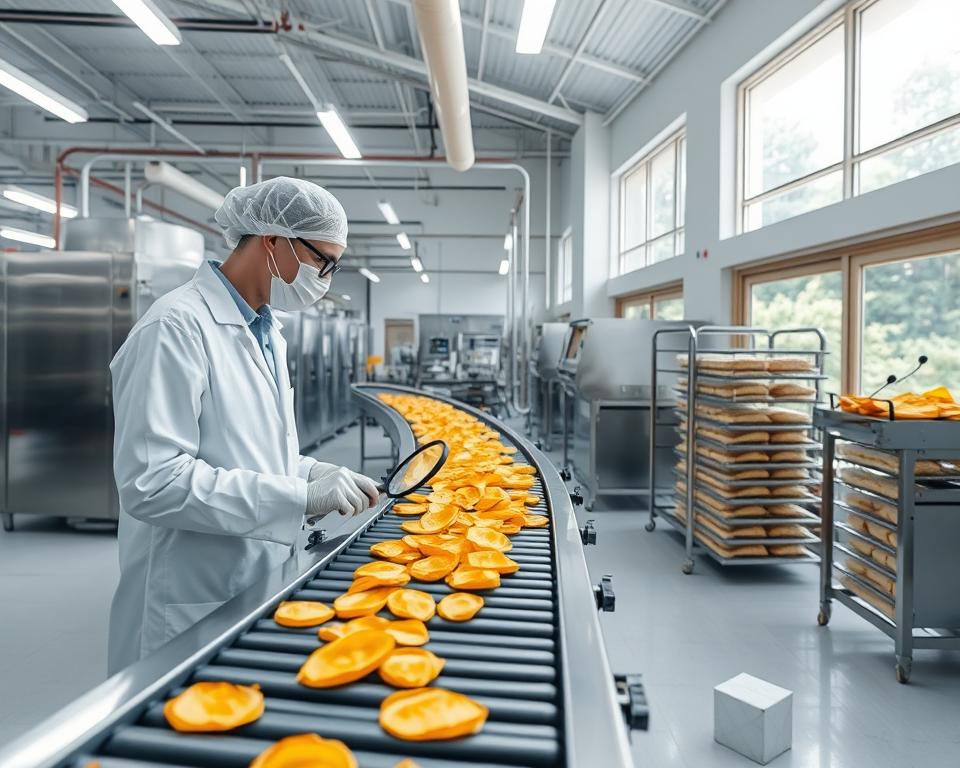
A strong food-safety program keeps consumers safe and opens new markets. Start with audits of suppliers and clear purchase orders. Keep track of every lot from the orchard to the pack for quick tracing.
Do daily checks in the plant with simple tools. Use refractometers, moisture meters, and pH meters for quality checks. These tools catch problems before they pack.
Lab tests catch things that simple tools miss. Test for microbes, pesticides, and heavy metals. Use labs that are certified to help with export needs.
Use HACCP for dried fruit to control key steps like blanching and packaging. Add ISO 22000 systems for bigger buyers. This aligns management and operational controls.
Keep good records. Log cleaning, batch samples, and any fixes. These help with audits from big buyers and food authorities.
Check the quality of dried mango with physical and taste tests. Look at °Brix, moisture, color, texture, and taste. This ensures it stays good on the shelf and tastes right.
Packaging and labels must follow rules for imports. List ingredients, net weight, and nutritional facts. Also, mention preservatives, storage tips, and where it’s from.
Lower risks of contamination and foreign objects. Use metal detectors and separate raw and finished goods. Make sure suppliers meet quality standards.
Decide if you’ll test in-house or outsource based on volume and cost. In-house tests are quick. Outsourced tests give detailed data for audits and exports.
Train staff on testing and recall plans. A good tracking system, quality checks, and documented fixes help fast. This protects your brand.
Operational planning: workforce, seasonality, and product mix
Starting a dried mango operation needs a good staffing plan. It should have skilled technicians, quality-control people, and flexible seasonal workers. Train technicians on dryer controls and maintenance. Quality-control staff should know how to check moisture, color, and microbiology.
Seasonal workers need quick training on hygiene and safety. This helps reduce mistakes and speeds up work during busy times.
Seasons affect what you buy and make. Working with local farmers and using cold storage helps manage supplies. Buying different mango types can balance out the supply and quality.
Adding other dried fruits like mango powder or fruit mixes can keep sales up all year. This helps when fresh mangoes are hard to find.
Choose products that fit the market. High-end dried mango needs strict quality checks and nice packaging. But, bulk orders for factories need simpler packaging and bigger batches.
Plan your factory’s capacity for the busiest times. Make sure you have space for raw fruit and finished products. Also, have a time for maintenance when it’s slow.
Keep costs down by watching how much dry matter you get from each mango. Adjust slice thickness and drying times to save energy without losing quality. Have spare parts, backup power, and clear steps for work to cut down on downtime.
Match your sales plan with what you can do. Make sure you have the right certifications and tests for exports, retail, or ingredient sales. This way, you can meet buyer needs and grow your business.